Anatomy of a Starlink referral link, piece by piece
Five parts, one job. Once you can read the address, you can tell a working referral link from a broken or fake one in seconds.
Key takeaways
- A referral link has five parts: https://, the starlink.com domain, a page path, the ?referral= parameter and the RC- code.
- The domain must end in exactly starlink.com before the first single slash. Anything else is another website.
- The code lives after ?referral=. If that part is missing or cut short, there's nothing to apply.
- Extra tracking tags like utm_source don't carry the code. Leave them, but don't rely on them.
- Starlink doesn't publish a format spec for the code. RC- followed by groups of digits is what real links show.
On this page
- Why the link and the code are one thing
- Part 1: https://
- Part 2: the domain (www.starlink.com)
- Part 3: the path (/residential or /roam)
- Part 4: the parameter (?referral=)
- Part 5: the code (RC-…)
- What you can safely ignore
- Reading a link in ten seconds
- Five links, read
- Why each part is there
- Common mistakes
- What to do next
- Questions people ask
- Sources
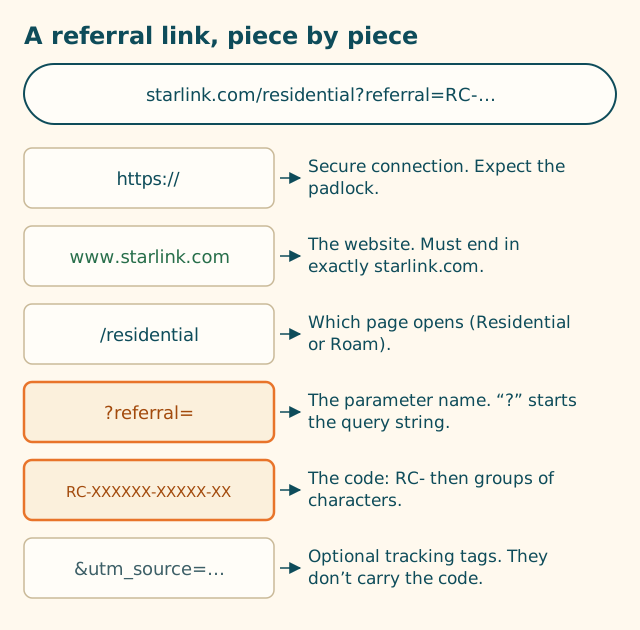
A Starlink referral link has five parts: https:// (a secure connection), www.starlink.com (the website), a page path such as /residential or /roam, the parameter ?referral=, and the customer’s code, which starts with RC-. Put together it looks like https://www.starlink.com/residential?referral=RC-XXXXXX-XXXXX-XX. The two parts that make it a working referral link are the website (it must be exactly starlink.com) and the code after ?referral=. Everything else is either routing or optional.
Why the link and the code are one thing
Starlink’s US Referral Program Terms don’t treat “the code” and “the link” as two separate tools. They define one thing, the “Unique Referral Link”, as the personalized hyperlink or code generated for a Referrer through the SpaceX Customer Portal or other authorized channel for the purpose of tracking referrals under the Program.
The code is the identifying part; the link is the vehicle that carries it to checkout. Starlink’s steps for new customers begin with opening the link, and we found no box at US checkout to type the code into. That’s why being able to read the link matters: it’s the only form of the code that reaches the order.
For the bigger picture on code vs link, see our code vs link explainer.
Part 1: https://
The scheme. https means your browser and the website talk over an encrypted connection, and most browsers show a padlock or similar icon. A referral link should start with https://. If a link someone sends you starts with plain http://, the site will usually redirect you to the secure version, but it’s a small sign that the link was typed or edited by hand rather than copied from Starlink. Our link checker flags it.
Part 2: the domain (www.starlink.com)
This is the part that decides whose website you’re on, and it’s the part fake links abuse. The rule: read the address up to the first single slash after https://. That stretch must end in starlink.com.
| Address starts with | Whose site? |
|---|---|
https://www.starlink.com/… |
Starlink |
https://starlink.com/… |
Starlink (same site, no “www.”) |
https://starlink.com.order.example/… |
order.example, not Starlink |
https://starlink-promo.example/… |
starlink-promo.example, not Starlink |
https://www.starIink.example/… (capital I) |
Not Starlink |
The .example addresses above are made up for illustration; the tricks are real. Our look-alike domain guide goes through them in detail. A code only works on starlink.com, so if the domain is wrong, the code in the link is irrelevant: close the page.
Part 3: the path (/residential or /roam)
After the domain comes the path, which says which page to open. Referral links we’ve seen use /residential (home service) or /roam (portable service). Starlink’s help article tells new customers to “Sign up for Residential or Roam service on starlink.com”, and those are the two plan families its referral credit is listed for.
Does the path matter? It decides your starting page. If you want Roam and the link opens Residential, you can navigate across, but Starlink doesn’t publish whether the referral stays attached when you switch pages, and we haven’t confirmed it either way. If the plan family matters, ask the sender whether they can send a link that opens the right page, or check carefully for “Referral Code Applied” before paying. Our plan-by-plan table lists every plan on the referral list.
Part 4: the parameter (?referral=)
Everything after the ? is the query string. MDN’s web documentation describes it as a string containing a “?” followed by the parameters of the URL.
Each parameter is a name=value pair, and pairs are joined with &.
In a Starlink referral link:
?starts the query string,referralis the parameter name,=separates the name from its value.
This is where links break most often. Some apps, shorteners and security tools trim or rewrite everything after ?. If you open a link and the address bar shows just https://www.starlink.com/residential with nothing after it, the code didn’t make it. See shortened referral links and work laptops that rewrite links.
Part 5: the code (RC-…)
The value after referral= is the customer’s code. In real links shown by a third-party retailer, it starts with RC- and continues with groups of digits separated by hyphens. Starlink doesn’t publish a format specification, so treat this as the observed pattern rather than a guarantee. Two things you can rely on:
- If it doesn’t start with
RC-, it isn’t a Starlink referral code. Codes likeSAVE50orFREEMONTHare store-style promo codes, and Starlink’s US checkout has nowhere to use them. See referral code vs promo code. - Each customer’s code is different. It identifies whose referral the order counts toward. That’s why we never print a real code as an example: every example on this site uses X’s.
We don’t know whether the code is case-sensitive or whether a single wrong character fails quietly or loudly. Starlink doesn’t say. Copying the link whole, rather than retyping it, avoids the question.
What you can safely ignore
Sometimes a referral link has extra parameters after the code, joined with &:
https://www.starlink.com/residential?referral=RC-XXXXXX-XXXXX-XX&utm_source=…&utm_medium=…
Parameters starting with utm_ are standard marketing tags that tell a site where a visitor came from. They don’t carry the referral code. You don’t need them, but there’s also no reason to delete them: editing a link by hand is the most common way people accidentally cut off the code itself. Leave the link as you received it.
Reading a link in ten seconds
- Find the first single slash after
https://. Does the text just before it end instarlink.com? If not, stop. - Find the
?. Isreferral=right after it? - Look after the
=. Does it start withRC-and run to the end (or to an&)? - Is anything strange at the very end? A stray period, quote mark or bracket picked up during copying can break the code.
If all four check out, open it in the browser you’ll pay in and look for “Referral Code Applied” on the order page, which a third-party walkthrough reports appears before you submit.
For a new US customer, a working link means one free month of service on the eligible plan you choose, credited to the second bill.
Five links, read
Practice on these. Each one tests a different part.
| Link | Verdict | Why |
|---|---|---|
https://www.starlink.com/residential?referral=RC-XXXXXX-XXXXX-XX |
Good | Right site, Residential page, code present |
https://starlink.com/roam?referral=RC-XXXXXX-XXXXX-XX&utm_source=newsletter |
Good | Right site, Roam page, code present; the utm tag is harmless |
https://www.starlink.com/residential |
No code | Right site, but nothing after the path; ask for the full link |
https://www.starlink.com/residential?referral=RC-XXXXXX-XXXX |
Probably cut short | The code is shorter than usual, often a sign the copy stopped early; recopy the whole link |
https://starlink.com.signup.example/residential?referral=RC-XXXXXX-XXXXX-XX |
Not Starlink | The domain is signup.example; the code-shaped part is bait |
The fourth row deserves a note. Starlink doesn’t publish how long a referral code is, so “shorter than usual” is a hint, not proof. If a code looks shorter than the one in the sender’s account, recopying the link from the original message settles it.
Why each part is there
It helps to know the job each part does, because that tells you which parts can vary and which can’t:
https://and the domain get you to Starlink’s servers securely. They can’t vary.- The path picks a starting page. It can vary (
/residential,/roam), and it changes where you begin, not who referred you. - The parameter name tells starlink.com what the value is. It must be
referral. - The code tells starlink.com whose referral this is. It must be exactly the customer’s code.
- Tracking tags tell someone where a click came from. They can vary or be absent.
Common mistakes
- Reading the domain left to right and stopping at “starlink”.
starlink.com.order.examplecontains “starlink.com” but belongs to order.example. - Trimming the “messy” end. The messy end is often the code.
- Retyping from a screenshot. Copy text instead.
- Building a link by hand from a bare code. Starlink doesn’t say whether a hand-built link counts the same as the one copied from the customer’s account.
What to do next
Paste any link you’ve been sent into our link and code checker. It reads each part for you, in your browser, without sending what you paste anywhere. Then follow the where-to-enter walkthrough.
Questions people ask
What does a Starlink referral link look like?
It's a starlink.com web address with the code on the end, in the shape https://www.starlink.com/residential?referral=RC- followed by the code. The page part may be /residential or /roam.
What is the ?referral= part of the link?
It's a URL parameter. The question mark starts the query string, referral is the parameter's name and everything after the equals sign is its value: the customer's RC- code.
Does it matter if the link says /residential or /roam?
It decides which plan page opens first. Starlink's help article doesn't say whether the referral survives switching between the two, so if you want Roam, a link that opens the Roam page is the simpler route.
Can I delete the utm_ parts of a referral link?
They're tracking tags and don't carry the referral code. But editing a link by hand is how the code gets cut off by mistake, so it's safest to leave the link exactly as you received it.
Are Starlink referral codes always RC- plus numbers?
Real referral links we've seen use RC- followed by groups of digits. Starlink doesn't publish a format spec, so treat that as a pattern, not a rule. A code without RC- isn't a Starlink referral code.
Is www.starlink.com different from starlink.com?
No, both are Starlink's site. What matters is that the address ends in starlink.com before the first single slash, with nothing added after .com.
Related guides
Shortened referral links: see where they go first
A shortened link could be a working referral, a plain starlink.com page or a different website entirely. You can't tell by looking. Here's how to find out without risk.
Look-alike domains: spotting starlink.com imitations
A fake site can copy Starlink's look perfectly. It can't copy the address. Learn to read the address, and the disguise stops working.
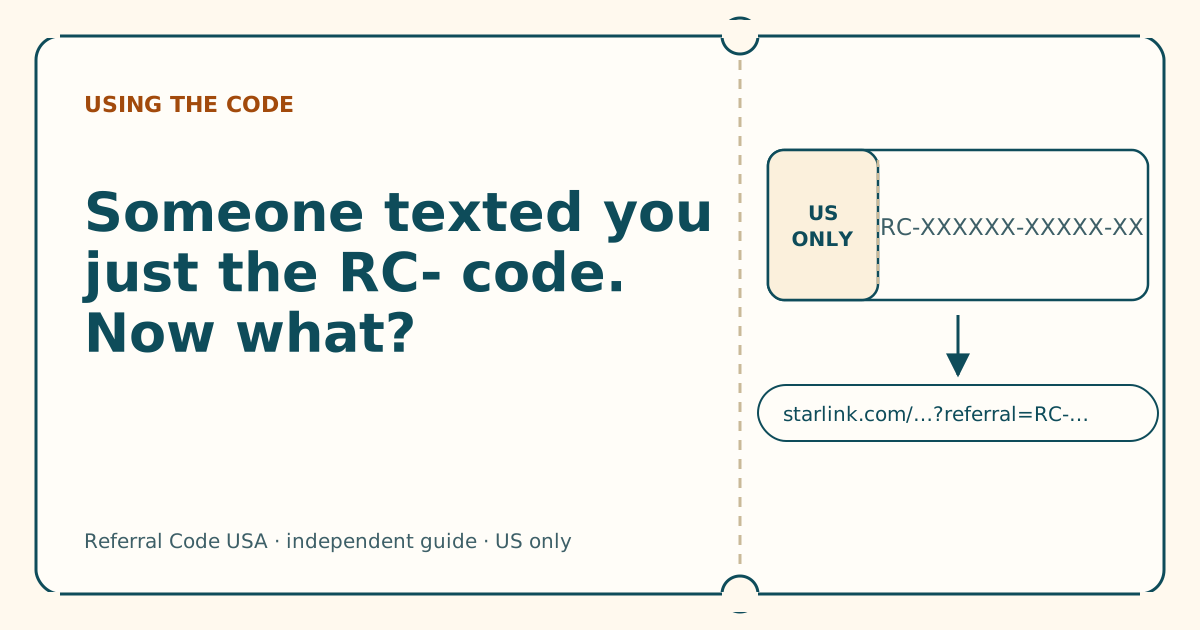
Someone texted you just the RC- code. What now?
A code on its own can't be typed in anywhere. Ask for the full link, check it, then open it in the browser you'll pay in.
Sources
What we read for this article, and when. Prices on this site come from one data file, re-read at least every 30 days.
- Referral Program Terms, US (DOC-1882-84808-83), retrieved
- How do I use a referral link? (Starlink help center), retrieved
- URL: search property (MDN Web Docs), retrieved
- Starlink referral page showing the link format (Outcamp, an Australian retailer), retrieved
- How to Use Starlink's Referral Program (DISHYtech, third-party guide), retrieved
Spotted something out of date? Report it, and see how we check claims.
Independent · not affiliated with SpaceX. Referral Code USA is an independent site. Some pages may show our own Starlink referral code; if you order with it, we may receive a referral reward from SpaceX. That never changes what an article says, and articles about scams carry no code at all. How we make money.