How to spot a fake Starlink promo code
Fake codes are easy to spot once you know the one fact behind them: Starlink's US checkout has no box for a code. Everything else follows from that.
Key takeaways
- We found no public US Starlink promo code and no box at checkout, so any typed “promo code” is suspect from the start.
- Red flags: store-style codes, fees or card details to unlock, non-starlink.com links, too-good offers, pressure, and installs.
- A real referral is free, comes as a starlink.com link from someone you know, and gives one free month.
- Starlink says it never asks for payment through a third-party vendor or website.
- If you paid or shared details, call your bank or card company, change passwords, and report it at ReportFraud.ftc.gov.
On this page
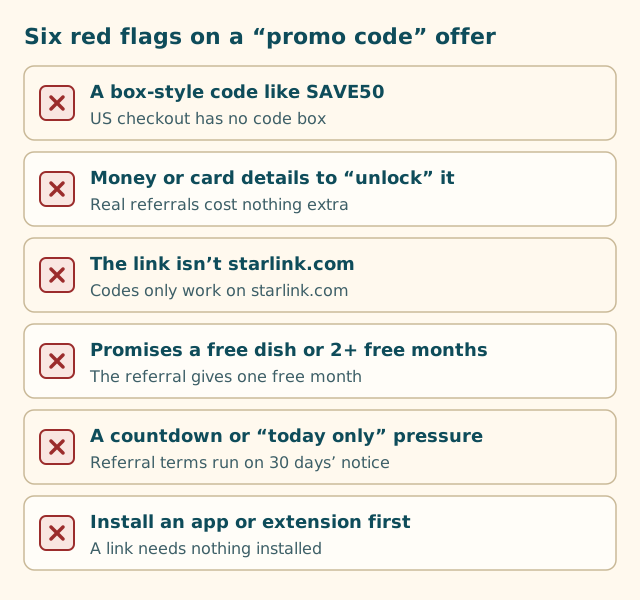
A fake Starlink promo code is easy to spot once you know one fact: we found no public US Starlink promo code and no box at checkout to type one into. So any offer built around typing a code is suspect from the start. The six red flags are: a store-style code (like SAVE50), a request for money or card details to “unlock” it, a link that isn’t starlink.com, a promise bigger than one free month, countdown-style pressure, and a request to install something. A real referral is free, arrives as a starlink.com link from someone you know, and gives one free month.
The six red flags
1. It’s a store-style code
SAVE50, FREEMONTH, STARLINK100, DISH2026. These are the shape of codes you type into a box. Starlink’s US checkout, as far as we found, has no box. Its promotional pricing terms say that where discounted pricing exists, you will see the discount service price offering at the time you place your order on starlink.com
, no code required. A store-style “Starlink code” can’t do anything. At best it’s useless; at worst it’s bait.
2. It costs money, or needs card details to “unlock”
A real referral costs the new customer nothing extra: you pay Starlink, on starlink.com, the same prices anyone pays. Starlink’s help center states that it will never ask for payment through a 3rd party vendor or website.
Any request to pay for a code, pay a “processing fee”, or enter card details anywhere other than starlink.com’s own checkout is a scam. See never pay for a referral code.
3. The link isn’t starlink.com
A referral code only works on starlink.com, inside the address. If the offer sends you to starlink-deals.example, starlink.com.offers.example or any other site, the “code” is irrelevant and the site may be built to collect your details. Read the web address up to the first single slash; it must end in starlink.com. Our look-alike domain guide shows the tricks.
4. It promises more than the program gives
Starlink’s terms describe what a referred new customer gets: one free month of service on the eligible plan they choose, credited to the second bill. Offers of “three free months”, “free dish”, “half price for a year” or “$200 off” with a code don’t match anything Starlink publishes for US customers. The old 12-month plan with a no-cost kit is discontinued for new activations, per Starlink, so even “free kit” offers that cite it are out of date.
5. It pressures you
Countdown timers, “only 3 codes left”, “expires at midnight”, “today only”. Starlink’s referral program isn’t run like that: its terms say changes come with 30 days’ notice. Pressure is there to stop you checking. Take your time.
6. It wants you to install something
“Download our app to get the code”, “add this browser extension”, “update your browser to view the offer”. A referral link needs nothing installed. Extensions and apps can read what you browse or worse. Close the page.
What a real referral looks like
| Real referral | Fake “promo code” | |
|---|---|---|
| Form | A starlink.com link ending in ?referral=RC-… |
A typed code, or a link to another site |
| Source | Someone you know who has Starlink | Ads, comments, pop-ups, cold messages, coupon pages |
| Cost to you | Nothing extra | A fee, a gift card, crypto, or your card details |
| What you get | One free month, credited to bill 2 (new customers on starlink.com) | Nothing, or a stolen card number |
| Where you pay | starlink.com’s own checkout | Anywhere else |
A real link looks like https://www.starlink.com/residential?referral=RC-XXXXXX-XXXXX-XX (X’s stand in for the real code). Our anatomy of a referral link explains each part.
How to check any offer in a minute
- Is it a link or a code? A bare store-style code: set it aside. An
RC-code: ask the person for their full link. - Where does the link go? Paste it into our link and code checker. It runs in your browser and doesn’t send what you paste anywhere. It flags look-alike domains, other sites, shortened links and links with no code.
- Who sent it? A friend or relative who has Starlink: good sign. A stranger, an ad, a comment thread, a dating match, a pop-up: bad sign.
- What does it ask of you? Anything beyond “open this starlink.com link”: stop.
- Does the offer match the program? One free month, credited to the second bill. Anything bigger: stop.
What to do if you were fooled
Don’t be embarrassed; these pages are built to look convincing. Act quickly instead.
If you paid for a code
- By card: call your bank or card company now and ask about disputing the charge.
- By gift card: the FTC says
Only scammers will tell you to buy a gift card
and pay with the numbers. Contact the gift card company right away (some can freeze remaining balances) and keep the card and receipt. - By payment app, wire or crypto: contact the app, your bank or the exchange immediately. Recovery is harder, so speed matters.
If you entered personal details or passwords
Starlink’s help center says that if you already clicked a link or shared personal information:
- delete the message and block the sender,
- update your Starlink password, and don’t reuse the same email and password combination for any other services,
- contact your financial institution if you entered payment information.
If you shared your Social Security number or bank details, the FTC points to IdentityTheft.gov for next steps.
If you installed something
Uninstall the app or extension. The FTC’s advice for possible malware is to update your security software, run a scan and remove anything it flags.
Report it
- Fraud and scams: ReportFraud.ftc.gov (the FTC’s reporting site).
- Scam texts: forward to SPAM (7726), per the FTC.
- Phishing emails: forward to reportphishing@apwg.org, per the FTC.
- A fake site using Starlink’s name: you can also contact Starlink through the support options linked from starlink.com.
Examples, decoded
Here are five offers in the shapes they usually take. All are made up for illustration; any resemblance to a real account is accidental.
1. A text from an unknown number. “Starlink: your discount code SL-SAVE75 expires tonight. Claim at starlink-rewards.example.” Three flags at once: a store-style code, pressure, and a site that isn’t starlink.com. Delete it. Starlink’s help center says genuine messages won’t ask for your details, and you can forward scam texts to SPAM (7726), as the FTC suggests.
2. A comment under a video. “Use my code RC-XXXXXX for 3 free months!!” The RC- shape is right, but the promise is wrong: the referral gives one free month. And a bare code in a comment has nowhere to go. Skip it; ask someone you know for their link instead.
3. A search ad. “Starlink Promo Code: 50% Off Today. Verified.” The headline promises a code; the ad’s link goes to a coupon page or a look-alike site. Look at the address it actually opens. If it isn’t starlink.com, close it.
4. A pop-up on an unrelated website. “Congratulations! You’ve been selected for a free Starlink kit. Just pay a small shipping fee.” A prize you didn’t enter, a small fee, and a card form: a textbook card-harvesting scam. Close the tab without clicking inside the pop-up.
5. A direct message after you asked about Starlink in a group. “I work with Starlink and can get you a special code. Send me your address and I’ll check it.” Starlink’s referral terms bar referrers from presenting themselves as Starlink employees or agents, and from collecting your personal data. Anyone offering this isn’t a real route. Decline and don’t share your address.
| Offer | Store-style code | Fee or card | Not starlink.com | Too good | Pressure | Install |
|---|---|---|---|---|---|---|
| 1. Text | ✕ | ✕ | ✕ | |||
| 2. Comment | ✕ | |||||
| 3. Search ad | ✕ | ✕ | ✕ | ✕ | ||
| 4. Pop-up | ✕ | ✕ | ✕ | |||
| 5. DM | ✕ |
One flag is enough. Most fakes carry two or three.
Why fake codes exist
Because people search for them. “Starlink promo code” is a common search, and wherever people search for a code, someone will offer one: coupon sites with generated pages (mostly useless rather than malicious, see why coupon sites list Starlink codes that do nothing), and scammers using a code as the hook for a fee, a card number or a login.
The honest answer, on our promo code page, is less exciting: no public US promo code; promotional pricing appears automatically for some addresses; and the referral, from someone you know, is the one code-shaped saving.
What to do next
Check any link with our link and code checker, read look-alike domains, and if you want the referral, ask someone you know for their link.
Questions people ask
Are Starlink promo codes real?
We found no public US Starlink promo code, and no box at checkout to type one into. The real savings are promotional pricing that appears automatically for some addresses and the referral, which comes as a link.
How can I tell if a Starlink code is fake?
If it's a store-style code like SAVE50, asks for money or card details, sends you to a site that isn't starlink.com, promises more than one free month or a free dish, pressures you with a countdown, or asks you to install something, treat it as fake.
What does a real Starlink referral look like?
A starlink.com web address ending in ?referral=RC- and a code, shared by someone you know who has Starlink. It costs nothing to use.
I paid for a Starlink code. What should I do?
Contact your bank or card company right away and ask about disputing the charge. If you paid with a gift card, contact the gift card company. Report it at ReportFraud.ftc.gov.
I entered my Starlink password on a fake site. What now?
Starlink's help center says to update your Starlink password and not reuse that email and password combination elsewhere, and to contact your bank if you entered payment information.
How do I report a fake Starlink promo code site?
Report fraud to the FTC at ReportFraud.ftc.gov. The FTC also lists forwarding scam texts to SPAM (7726) and phishing emails to reportphishing@apwg.org.
Related guides
Look-alike domains: spotting starlink.com imitations
A fake site can copy Starlink's look perfectly. It can't copy the address. Learn to read the address, and the disguise stops working.
Never pay for a Starlink referral code
Every current Starlink customer has a referral link they can share for free. Anyone charging for one is selling something that costs nothing, or nothing at all.
Why coupon sites list Starlink codes that do nothing
A coupon page for Starlink looks like every other coupon page. The difference is that Starlink's US checkout has nowhere to use what it gives you.
Sources
What we read for this article, and when. Prices on this site come from one data file, re-read at least every 30 days.
- Phishing or suspicious emails or texts claiming to be from Starlink (Starlink help center), retrieved
- How to recognize and avoid phishing scams (FTC Consumer Advice), retrieved
- Avoiding and reporting gift card scams (FTC Consumer Advice), retrieved
- Promotional Service Pricing Terms of Service (Starlink help center), retrieved
- Referral Program Terms, US (DOC-1882-84808-83), retrieved
- How do I use a referral link? (Starlink help center), retrieved
Spotted something out of date? Report it, and see how we check claims.
Independent · not affiliated with SpaceX. Referral Code USA is an independent site. Some pages may show our own Starlink referral code; if you order with it, we may receive a referral reward from SpaceX. That never changes what an article says, and articles about scams carry no code at all. How we make money.