An AI chatbot gave you a Starlink promo code. Check this first
A chatbot can invent a confident, tidy-looking code in seconds. The US checkout has no box to type it into, which is the quickest way to know it isn't real.
Key takeaways
- AI assistants can produce confident answers that are false. NIST calls this “confabulation”, colloquially “hallucinations”.
- A code like STARLINK50 from a chatbot has nowhere to go: the US checkout has no promo or referral code box.
- Starlink's discounts either show up on their own at checkout for your address, or come from a referral link.
- Check any AI answer against Starlink's own help center or the order page on starlink.com, not against the assistant.
- Never pay for, or hand card details to, a page an assistant pointed you to for a code.
On this page
If an AI chatbot gave you a Starlink promo code, it almost certainly made it up. AI assistants can produce answers that sound confident and are simply false. The US government’s AI risk framework from NIST calls this “confabulation”, and most people call it hallucination. The quickest check needs no technical knowledge at all: the US Starlink checkout has no box for typing a promo or referral code. A code like STARLINK50 has nowhere to go. What does exist is automatic promotional pricing in select areas, which appears on its own when you order on starlink.com, and the referral benefit, which reaches the order through a referral link. Check any AI answer against Starlink’s own pages, never against the assistant.
Why assistants invent codes
A chatbot doesn’t look up a Starlink database when you ask for a promo code. It writes the most likely-sounding reply, based on patterns in the text it learned from. And the web is full of coupon pages that list brand-name “codes” in capital letters with percentages beside them. So a request for a “Starlink promo code” pulls the assistant towards an answer shaped like those pages.
NIST’s Generative AI Profile (NIST AI 600-1, July 2024) lists confabulation as one of the main risks of generative AI. It defines it as “the production of confidently stated but erroneous or false content (known colloquially as ‘hallucinations’ or ‘fabrications’) by which users may be misled or deceived.” A made-up promo code is a textbook case. It looks specific, it’s stated with confidence, and it’s wrong.
Three things make Starlink codes especially prone to this:
- The words don’t match reality. People search for a “promo code”, but the US referral works through a link. An assistant trained on general shopping text expects a code box that isn’t there.
- Old or foreign information. Starlink’s offers change, and they differ by country. An assistant may repeat something from another market or an offer that has since ended, such as the 12-month free-kit option, which is now discontinued.
- Coupon-site noise. Many coupon pages list codes for Starlink that do nothing. If those pages were in the training data, the assistant learned the noise. See why coupon sites list Starlink codes that do nothing.
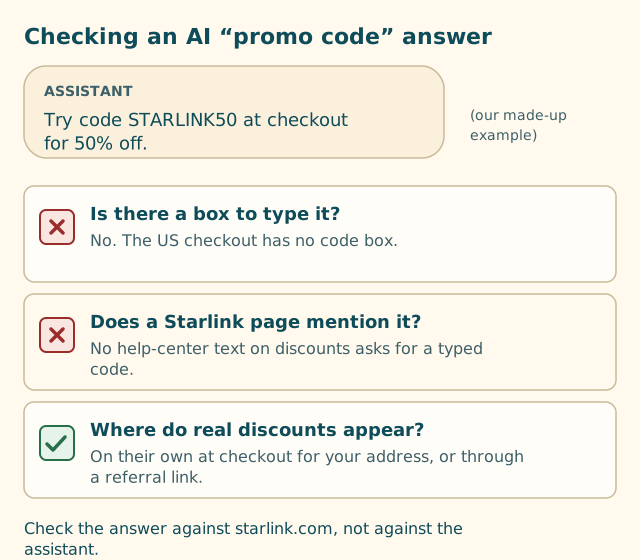
What an invented answer looks like
The code in our diagram is our own invention, written to show the pattern. We don’t repeat codes that real assistants have produced. Typical signs:
| What the answer says | Why it doesn’t hold up |
|---|---|
| A word-and-number code such as STARLINK50 or SAVE20 | The US checkout has no code box to type it into |
| “Enter it in the promo field at checkout” | There’s no such field; Starlink’s referral steps start with opening a link |
| A percentage off the dish or the monthly price | Starlink’s help center describes promotional pricing as shown automatically for your address, not unlocked by a code |
| “Valid until the end of the month” | The date is invented along with the code |
| “Two or three free months with this code” | The referral benefit for a qualifying new customer is one free month of service on the eligible plan you choose |
| A link to a deals or coupon site | Referral credit only counts on starlink.com |
None of this means the assistant is trying to trick you. It means the answer wasn’t checked. The risk starts when an invented answer sends you to a page that does want something from you.
How to check any AI answer in two minutes
- Ask where it came from. Ask the assistant for the source page. If it can’t name a page on starlink.com, treat the answer as a guess.
- Open the source yourself. Don’t trust a summary of a page; read the page. Starlink’s help center articles on promotional pricing and referral links are short.
- Check the date. Starlink’s offers and terms change. The US Referral Program Terms were last published Oct 3, 2026, and Starlink can change the program on 30 days’ notice.
- Check the order page itself. Enter your service address on starlink.com and look at the price shown. If promotional pricing applies to your address, it shows there without a code. If you opened a referral link, look for the referral line before you pay.
- Look at the address bar. If an assistant’s link took you anywhere other than starlink.com, close it before typing anything.
Our link and code checker can help with step 5. Paste a link or a code into it, and it tells you whether it looks like a Starlink referral link, a bare code, a short link or another site. It runs in your browser and doesn’t send what you paste anywhere.
What’s actually true today
Here’s what Starlink publishes, as we read it on Oct 6, 2026:
- No public promo code. None of Starlink’s help-center text on discounts asks you to type a promo code. Discounts either appear on their own at checkout for your address or come from a referral link.
- Promotional pricing, where it exists, is automatic. Starlink’s promotional pricing terms say that in select areas, new customers can get discounted service pricing for a fixed period, and that if it’s available in your area, you’ll see it when you place your order on starlink.com. The terms also say changing plan, cancelling or being suspended ends it.
- Regional Savings isn’t a US program right now. Starlink’s Regional Savings article lists only Mexico.
- The referral travels in a link. The referral terms define the “Unique Referral Link” as “the personalized hyperlink or code generated for a Referrer” and say “No other referral mechanism shall qualify.” Starlink’s own steps start with opening the link you were sent. The code inside it sits after
?referral=and is never typed. - What a referral gives the new customer: one free month of service on the eligible plan you choose, on the second bill, for a qualifying new customer with a US address who orders on starlink.com.
Our promo code page keeps this answer current, with dates, and our myths page collects the common false claims.
When an AI answer becomes a safety problem
Most invented codes just waste a minute. They become a problem when they lead you somewhere. Stop if an answer, or the page it links to:
- asks you to pay for a code, by card, gift card, crypto or a payment app. A real referral costs nothing extra; see never pay for a referral code.
- sends you to a site that isn’t starlink.com and asks for your address, card or Starlink password. See look-alike domains.
- tells you to install a browser extension or app to “activate” the code.
- gives a phone number for “Starlink support” that you can’t find on starlink.com. Get support contacts from starlink.com itself.
The FTC’s advice on phishing applies here too: don’t click links you didn’t ask for, and don’t give personal or financial information to a page you reached by a link you can’t verify. If you’ve already typed card details somewhere, call your card company first.
A worked example
Say you ask an assistant, “What’s the Starlink promo code this month?” It replies with a capitalized code, a percentage, and “enter it in the promo field at checkout”.
- You go to starlink.com, enter your service address and choose a plan. There’s no promo field anywhere, so the code has nowhere to go.
- You ask the assistant for its source. It names a coupon site, not a Starlink page.
- You check Starlink’s promotional pricing article instead. It says discounted pricing, where offered, shows up when you place your order. The price on your order page is what your address gets.
- A friend who has Starlink sends you their referral link. You open it, pick your plan and see the referral line on the order page before paying.
The assistant’s code added nothing. The order page and a friend’s link were the whole story.
What we don’t know
- Which assistants give invented Starlink codes, and how often. Their answers change with every version, and we don’t run systematic tests.
- Whether a given assistant uses live web search or only its training data for a particular answer. Many show their sources; if yours doesn’t, assume it’s working from memory.
- Whether Starlink will ever add a code box to the US checkout. Nothing it publishes suggests one (checked 2026-10-06). If that changes, our news log will say so.
Common mistakes
- Treating a confident answer as a checked one. Confidence is how these models write, not a sign they verified anything.
- Trying code after code. There’s no field, so no code works, and no combination gets a bigger discount.
- Following the assistant’s link without reading the address. Read the domain first. It must be starlink.com.
- Asking the assistant whether your code applied. Only the order page can show that.
- Ignoring the real route. If you know a current customer, their referral link is the thing that changes your order.
What to do next
Read our honest promo code answer, check any link with the link and code checker, and if you have a referral link, follow the where-to-enter walkthrough to the order page.
Questions people ask
Why did ChatGPT or another AI give me a Starlink promo code?
AI assistants predict likely-sounding text. Asked for a promo code, they can produce something that looks like one, built from patterns on coupon pages. NIST's generative AI profile calls confidently stated but false output “confabulation”. The code isn't checked against Starlink.
Do AI-generated Starlink promo codes work?
There's nowhere to use one. The US checkout has no box for typing a promo or referral code, and none of Starlink's help-center text on discounts asks you to type a code (checked 2026-10-06).
Is there a real Starlink promo code in the US?
Not a public one. In select areas, Starlink shows promotional pricing automatically when you order on starlink.com. The referral benefit for a new customer comes through a referral link, not a typed code.
The AI gave me a link instead of a code. Is it safe?
Read the address before opening it. It must be on starlink.com. If it goes to another site, or the assistant can't say where it came from, don't open it and never type card details into the page.
Can an AI assistant check whether my referral code is applied?
No. Only the order page on starlink.com can show that. Look for the referral line (reported as “Referral Code Applied”) on the order page before you pay.
How should I ask an AI about Starlink discounts?
Ask it to cite Starlink's own help pages, then open those pages yourself and read the date. If it can't point to a starlink.com source, treat the answer as a guess.
Related guides
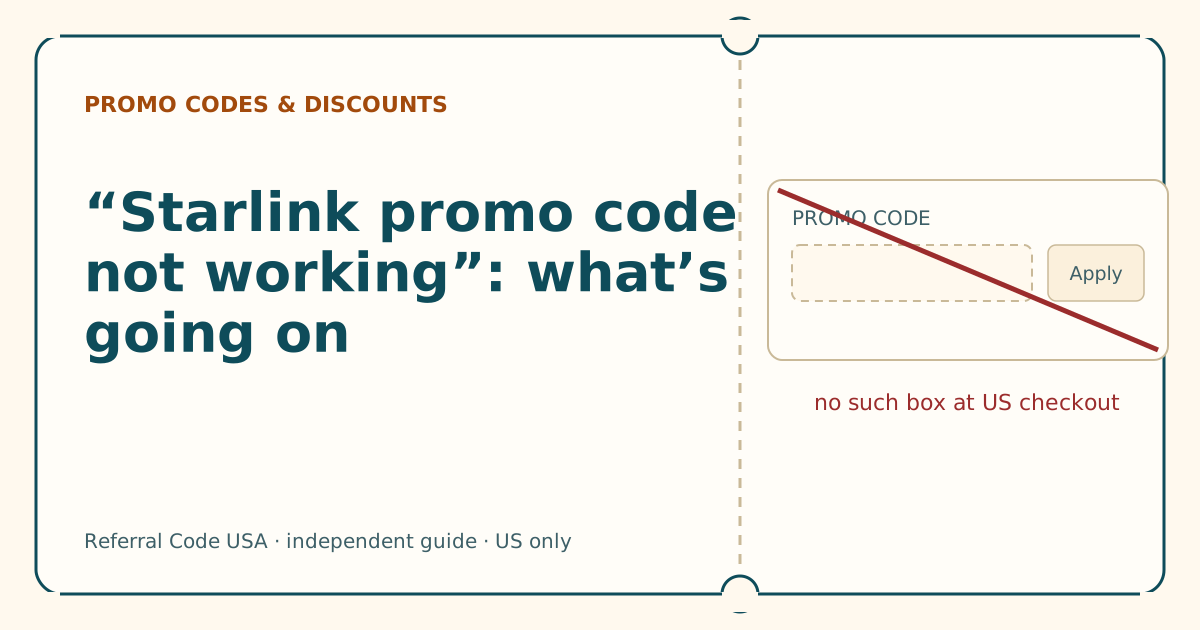
“Starlink promo code not working”: what's going on
It isn't a typo, an expired code or bad luck. A typed promo code has nowhere to land at Starlink's US checkout. Here's how to tell what happened in your case.
How to spot a fake Starlink promo code
Fake codes are easy to spot once you know the one fact behind them: Starlink's US checkout has no box for a code. Everything else follows from that.
Why coupon sites list Starlink codes that do nothing
A coupon page for Starlink looks like every other coupon page. The difference is that Starlink's US checkout has nowhere to use what it gives you.
Sources
What we read for this article, and when. Prices on this site come from one data file, re-read at least every 30 days.
- Artificial Intelligence Risk Management Framework: Generative Artificial Intelligence Profile, NIST AI 600-1 (July 2024), retrieved
- Promotional Service Pricing Terms of Service (Starlink help center), retrieved
- How do I use a referral link? (Starlink help center), retrieved
- What are regional savings? (Starlink help center), retrieved
- Referral Program Terms, US (DOC-1882-84808-83), retrieved
- How to recognize and avoid phishing scams (FTC Consumer Advice), retrieved
Spotted something out of date? Report it, and see how we check claims.
Independent · not affiliated with SpaceX. Referral Code USA is an independent site. Some pages may show our own Starlink referral code; if you order with it, we may receive a referral reward from SpaceX. That never changes what an article says, and articles about scams carry no code at all. How we make money.